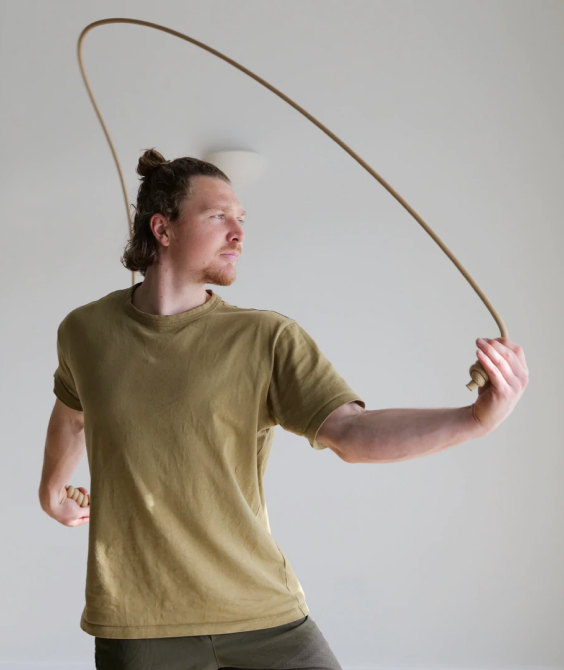
I see a lot of beginners attempt to learn the 'Alternating Sneak' pattern very early on in their practice - and whilst I generally have no problem with people exploring any pattern they desire at anytime - it's good to be aware that Sneaks requires intense shoulder mobility, torso rotation and wrist co-ordination that often hasn't yet been developed in beginners.
Instead, I feel it's better to explore how your body moves around the rope first, or break the sneak down into simpler mechanics that we can later build into a complete Alternating Sneak pattern.
So in this post I offer you alternative 3 pathways to consider learning next after you've nailed the Dragon Roll (on both sides!) instead of the Sneak, or to aid your learning of the Sneak.
Video version available HERE
Pathway 1: Dragon Roll Pivots
This is one of the very first concept I teach students after they learn the basic Dragon Roll in person. It connects the hands to the ground using full-body rotation.
- Overhand Direction (Heel-Side Pivot): During Dragon Roll - as the rope lands behing you on the "heel side," use this momentum to pivot 180 degrees on your lead leg (opposite leg from direction rope is swinging towards). You should stop facing the opposite direction and the rope ready to swing past your toes. Reverse the pivot to return to where you started.
- Underhand Direction (Toe-Side Pivot): During Dragon Roll - as the rope swings past your toes use this momentum to pivot 180 degrees on your lead leg (same leg as the direction the rope is swinging towards i.e. if the rope swings past your toes to the left, pivot on the ball of your left foot). Now try to land facing the opposite direction and the rope lands behind your heels ready to go again or reverse back where you came from.
- Chaining Variations: Practice these pivots on both the left and right legs. Once you master the stationary pivots, you can add forward/backward steps, or progress to the Double Dragon (where you jump and swap your feet mid-air). In total, there are 8 distinct pivot variations to master.
Pathway 2: One-Handed Sneaks & Shoulder Spirals
If you choose to tackle the sneak, strip away the complexity of using two hands simultaneously and focus on mastering the mechanics of one arm first.
- Important Note for the Sneak! While the Dragon Roll is a mirroring, open/close pattern, the Sneak requires one hand to follow the lead of the other (e.g., when the right hand supinates, the left hand pronates).
- Isolate with Shoulder Spirals: Put both handles into one hand and practice a 2-beat whipping motion SEEN HERE ("one-two, one-two") driven by the shoulder. This isolates the required wrist spiral and elbow whip.
- The 90-Degree Advantage: Practising one-handed gives you 90 degrees more spatial freedom. Master the spiral on your right side, master it on your left side, and only then close the angle back down to combine them into an alternating, two-handed sneak on the spot.
Pathway 3: Overhand and Underhand Matadors
Often overlooked by beginners, the Matador is an essential move that I continue to practice every single session, even five years into his journey.
- Graceful Weight Shifting: The Matador is a 4-beat pattern for one complete cycle. It teaches you to shift weight smoothly from one foot to the other without aggressive back-and-forth mechanics, allowing you to settle in, find balance, and even lift a leg if needed.
- Don't Skip the Underhand Matador: If I could restart his rope flow journey, I would start drilling underhand matadors within my first few sessions. While it feels clunkier and more awkward initially compared to the overhand version, the long-term benefits are substantial.
- The Real Magic (The Transition): The ultimate joy of this pathway comes from switching seamlessly back and forth between the overhand and underhand Matadors. This transition makes you feel the "cogs" of your body aligning—connecting the movement from your feet up through your ribs, arms, shoulder spirals, and wrist flicks. And develops into Patterns like the ACE (taught in my Fluidity Course and Level 2 Workshops).
- Sports Translation: Developing this fluid weight shift and learning to drive power from the feet up to the hands directly translates to all underhand, racket, ball, and martial arts sports.
Want to learn more?
In the 8-weeks to Fluidity Course - Mastering Dragon Roll is in the first 2 weeks and then in weeks 3-6 I take you through much of pathways described in this article.
Summary of Your Next Steps
After mastering the Dragon Roll, you have three distinct avenues to explore simultaneously or one by one:
- Dragon Roll Pivots (Mastering footwork and 180-degree changes)
- One-Handed Sneak Mechanics (Building shoulder spirals and wrist loops)
- Overhand & Underhand Matadors (Perfecting the graceful horizontal weight shift and pattern transitions)
Thanks for reading!
Tim
Video Version...